
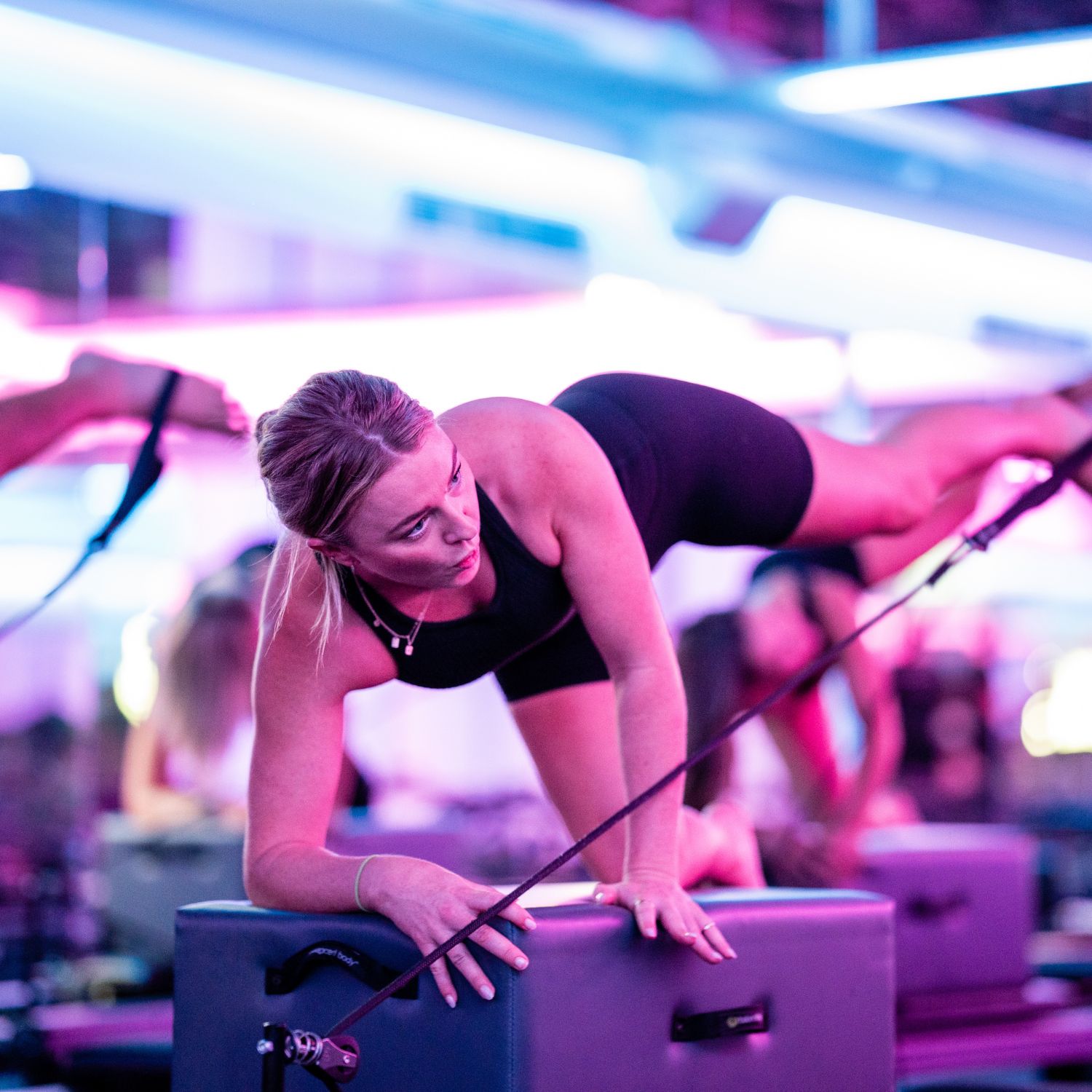
Strong glutes sit at the center of many strength goals – and for good reason.
As the largest muscle group in the body, the glutes generate much of the force behind how we stand, step, and move. But what exercises and movements are best for building strong glutes – and how can VAURA’s heart-pounding, neon-lit Pilates workouts help?
Glute training is often linked to high effort or heavy loading, but Pilates takes a different approach. Through controlled movement, sustained resistance, and precise positioning, Pilates glute exercises engage the full muscle group, rather than relying on load alone.
In this guide, we’ll explore why Pilates is so effective for building glute strength, then walk you through seven Pilates glute exercises to help you develop strong, capable glutes.
Why Pilates is effective for glute strength
Pilates is effective for glute strength because it trains all three glute muscles – the maximus, the medius, and the minimus – through controlled, repeatable movement (rather than isolated loading often seen in more typical gym workouts).
Pilates glute exercises place the hips in varied positions, requiring the glutes to work through their full range rather than in one fixed pattern.
Strong Pilates glutes will also support your:
- Posture – by helping to stabilize the pelvis during standing, walking, and sitting¹.
- Lower back comfort – by reducing the need for the lower back to compensate during movement¹.
- Balance – through improved control in single-leg and transitional movements¹.
- Power – by increasing the ability to drive movement through the hips when lifting or pushing through the legs¹.
7 best Pilates glute exercises (mat and reformer)
Want to experience the strength and power of Pilates glutes? Read on.
Below, we’ve pulled together our top seven Pilates glute exercises – the ones you’ll find most commonly incorporated into our mat and reformer workouts. Each one targets a key glute function and appears throughout a typical Pilates glute workout here at VAURA.
1. Glute bridge (mat)
The glute bridge targets the gluteus maximus through hip extension, while keeping the spine supported2. It builds strength through the hips and supports glute toning by repeatedly loading and controlling the movement back to the mat.
To perform this Pilates glute exercise:
- Lie on your back with knees bent and feet hip-width apart.
- Press through your heels to lift the pelvis until the hips align with the ribcage.
- Lower back to the mat with control.
To up the difficulty, try a single-leg glute bridge. Working one side at a time increases demand on the glutes and challenges pelvic stability, giving you a harder workout.
2. Clamshells (mat or banded)
Clamshells focus on the gluteus medius, which plays a key role in hip alignment and pelvic control2. This Pilates glute exercise is particularly beneficial for walking, running, and single-leg movement. Here’s how to do it:
- Lie on your side with knees bent and feet stacked.
- Keep the hips steady as you lift the top knee.
- Lower slowly without shifting the pelvis.
Adding a resistance band or a weight increases load through the outer glutes. Extending the body into a longer side-lying position also raises the challenge.
3. Side-lying leg lifts (mat)
This Pilates glute exercise targets the gluteus medius and minimus by loading the hip in abduction2. It helps build lateral strength and improves control through the pelvis.
To put it into practice:
- Lie on your side with legs extended.
- Lift the top leg slightly back and upward.
- Lower with control while keeping the hips stacked.
Progress this Pilates glute exercise by slowing the lift and descent to increase your glutes’ time under tension – or add small pulses at the top of the movement. When you join us for a workout at VAURA, our experienced trainers are always happy to help you modify each movement to accommodate for injury, or simply to help you get a better burn – just ask!
4. Footwork (reformer)
Reformer footwork strengthens your glutes as you push against spring resistance, using your hips to work through each press2. Switching between heel and toe positions slightly changes how the glute muscles engage. To perform this Pilates glute exercise:
- Lie on your back on the reformer with your feet placed on the foot bar.
- Set your shoulders into the shoulder blocks and rest your arms by your sides.
- Press the carriage away by extending through the hips.
- Control the return as the springs guide the carriage back in.
To increase the challenge when it’s time for your next VAURA workout, simply add more spring resistance – or perform the movement with one leg at a time.
5. Scooter (reformer)
The scooter is a Pilates glute exercise that builds single-side strength while challenging pelvic control2. The staggered stance increases load through the working hip, supporting strength and coordination.
To load your glutes effectively through the scooter:
- Stand on the reformer with one foot on the carriage.
- Press the carriage back using hip extension.
- Return slowly without shifting the pelvis.
To turn the scooter into a high-intensity Pilates movement, amp up the resistance or tempo.
6. Hip thrusts (reformer)
Hip thrusts build glute strength by lifting the hips into extension2.
You can perform hip thrusts on the mat, but we prefer them on the reformer. They require more control, so the glutes stay engaged through slower, more controlled movement – and more practiced Pilates breathwork.
To set up this Pilates glute exercise:
- Sit on the reformer with your shoulders supported and your feet placed on the foot bar.
- Exhale as you press through your feet and lift your hips against the springs, engaging your glutes while keeping your core braced.
- Inhale as you lower the hips with control.
To level up the movement and get an even better burn through the glutes, add spring resistance – or pause briefly at the top to keep the glutes working for longer.
[H3] 7. Swimming (mat)
‘Swimming’ involves working the glutes by lifting the legs (and arms) while keeping the core steady. It also works as a Pilates exercise for lower back pain by building the muscles that help stabilize the spine, while building strength through the hips2.
To perform this exercise:
- Lie prone with arms and legs extended.
- Lift opposite arm and leg while keeping the trunk stable.
- Alternate sides in a controlled rhythm.
Increase duration or reduce rest between sets to further challenge your glutes’ endurance.
Ready to get started with your Pilates glute exercises? Explore our top 10 tips to help you build motivation – and keep showing up for VAURA workouts, day in and day out!