
Reformer Pilates can look complex at first – with springs, straps, and moving parts that feel unfamiliar. If it’s your first Pilates class, it’s easy to feel like you need to know how everything works before you start – but in reality, Pilates is much simpler than it looks.
Pilates props aren’t there to complicate things – they guide your movement and help each exercise work more effectively. At VAURA, our instructor-led classes walk you through everything in a safe, supportive environment, so you know exactly what to do.
Below, we explain the most common Pilates props, why they matter, when we use them in our workouts – and how they can give you a better, more challenging Pilates workout.
What are Pilates props – and why do we use them at VAURA?
Pilates props are tools used during class to change the difficulty and purpose of each exercise. They can help you hold the correct position, increase resistance, or help you tailor workouts to your body’s needs by making certain movements more accessible.
At VAURA, we incorporate Pilates equipment into our high-intensity classes, combining traditional reformer Pilates with athletic training. Props extend the time your muscles stay under load, so each exercise increases strength and output without placing extra impact or strain on your body.
The Pilates props you’ll use in a VAURA workout
There are 34 traditional Pilates exercises1, but props create hundreds of variations. Below, we guide you through the Pilates equipment we use in our classes, explaining what each piece does and how to use it.
Reformer machine
The Pilates reformer machine is the foundation of every VAURA workout. It’s a bed-like machine with a sliding carriage, adjustable springs, straps, and pulleys that let you change resistance as you move. Alongside mat Pilates, reformer is one of the main styles of Pilates – and the one we specialize in here at VAURA!
Because the carriage of the reformer slides, your muscles don’t switch off between reps – they stay working to control the movement. That’s what makes reformer Pilates feel more demanding, even without extra strength work or fast-paced cardio.
Pilates ball
Pilates balls are used to either support your position or increase the challenge of an exercise. You might place one behind your head for comfort during side-lying work, or under your back to encourage stability and build core strength.
In our classes, we use two types:
- Squishy Pilates ball – used to support positioning or create instability, helping your core to stay engaged.
- Weighted Pilates ball – adds resistance to movements, increasing intensity and muscle engagement.
Pilates resistance bands
Pilates resistance bands work by adding tension through the full range of motion, so your muscles don’t switch off between reps – helping you build muscle strength and endurance.
When these bands come out in a workout, it’s a sign that the burn is about to really kick in. If your instructor tells you to grab one, you know you’ll feel it the next day!
At VAURA, we use bands across lunge series, bridge work, and even arm sequences, with our trainers constantly finding new ways to keep you challenged.
Pilates ring (magic circle)
The Pilates ring – often called the magic circle – was created by Joseph Pilates (the founder of Pilates), who believed it added an almost “magical” way to help you engage and hold your deep muscles during an exercise.
By placing it between your arms or legs and applying light pressure, it creates resistance that activates areas like your inner thighs, chest, and core. If you lose alignment, the ring moves – a clear sign you’ve come out of position and need to reset.
You’ll use the Pilates ring in our Stretch classes, which focus on deeper, slower movements inspired by yoga and Pilates. Here, it helps you move further into each stretch while building strength around your joints – improving flexibility, supporting recovery, and helping reduce the risk of injury.
Light dumbbells
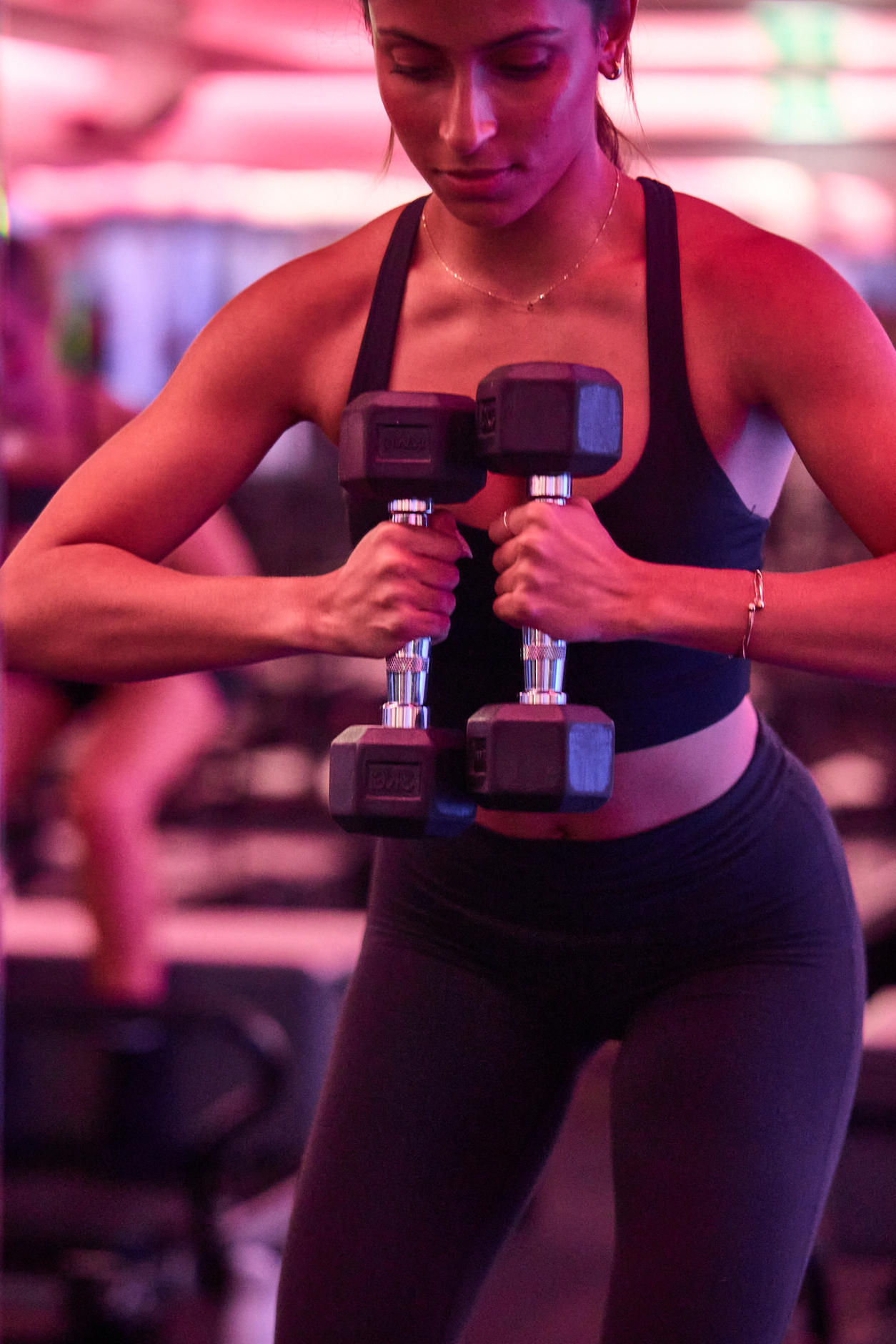
While the reformer springs provide most of the resistance, hand weights for Pilates add extra load, especially for upper-body work.
If you’re using Pilates to tone your arms, dumbbells increase the demand on each movement, so your muscles have to work harder to stay in control throughout each rep.
In our Total classes, dumbbells are layered into full-body sequences – keeping your upper body engaged while your lower body moves, so you train your entire body in one continuous, high-impact effort.
Ankle weights
Ankle weights create constant, light resistance that increases muscle activation through your legs and deep stabilizing muscles. Adding ankle weights offers an extra edge to movements like leg circles, flutter kicks, and tabletop, pushing more work into your core.
This added demand increases overall effort, which is why ankle weights are effective when using Pilates for weight loss, helping you burn up to 15% more calories2 while keeping the same flow of movement.
Jumpboards
A jumpboard is a Pilates board that attaches to the end of the reformer in place of the foot bar, creating a surface you can push off. It’s used to bring cardio into a reformer workout through controlled jumping movements.
The reformer springs absorb the impact of each jump, reducing pressure on your joints while still elevating your heart rate. Because you’re working in a supported, lying position, it’s a strong low-impact option – especially if you’re practicing Pilates during pregnancy.
Here at VAURA, we offer Jumpboard classes that focus on low-impact cardio, combining explosive lower-body work with controlled core and upper-body strength. This improves your cardiovascular fitness while toning your legs, without the joint stress of traditional cardio.
Box
By raising your position or supporting your body in different ways, a Pilates box helps increase the depth of a movement and challenges your balance.
You’ll hear our instructors refer to it as either a short box or long box, depending on how it’s set up:
- A short box is placed across the shoulder rests to create a stable platform, often used for exercises that focus on abdominal strength and spinal control.
- A long box is positioned lengthways along the carriage, supporting your torso in prone or supine positions while you work through upper- and lower-body movements.
What to expect in your first VAURA class
A common mistake to avoid as a Pilates beginner is thinking you need to know what to do before you walk into class. It’s normal to feel unsure around the equipment, but you’re not expected to figure it out alone. Our instructors guide you through every movement, explaining how each exercise works and how to set up your Pilates props.
They’re also watching the room throughout the entire class, helping you adjust your form, so you feel supported and confident as you move.
Ready to try a class? Find your closest VAURA studio and try your first class with guidance the whole way through.
Now that you know your way around a Pilates reformer machine, the next step is knowing what to wear to Pilates so you feel comfortable in your first session.
1 https://www.michaelmillerpilates.com/hermit/art/control.pdf
2 https://pubmed.ncbi.nlm.nih.gov/2930343/