
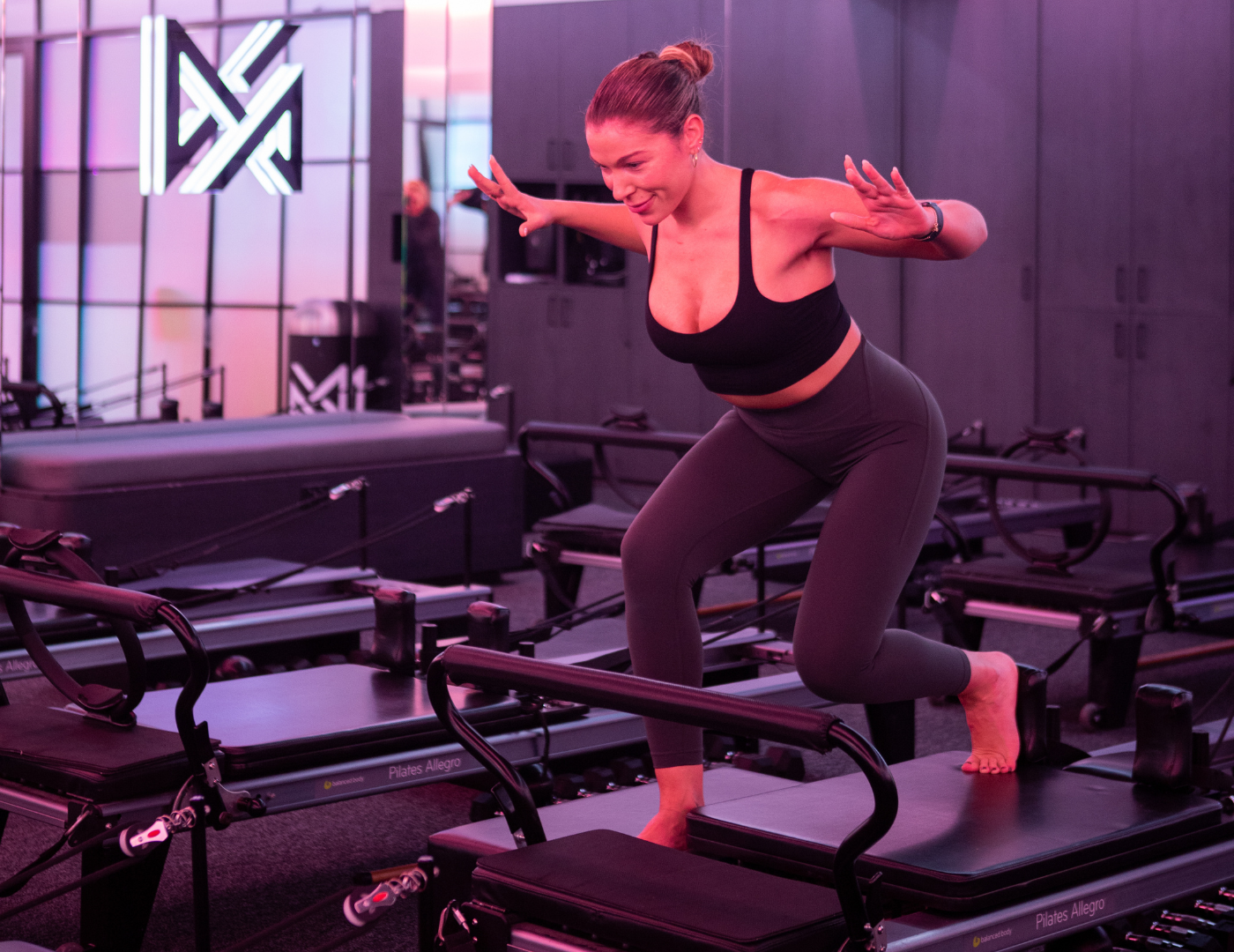
Stress doesn’t just sit in your mind – it shows up in your body.
As an example, take a moment to check in with yourself right now.
Are you clenching your jaw? Breathing quickly or shallowly? Are you sitting hunched over, with your shoulders rounded or tight?
These signs aren’t random – they’re how your body carries stress.
At VAURA, we use Pilates for stress relief as a tool to work through the mental and physical effects of this tension – using breathwork and mind-body connection to lower your heart rate and ease muscle tension, helping your body settle into a calmer, more balanced state.
Below, we break down how Pilates for anxiety and stress relief works in practice, with a guide to the exercises you’ll experience in our workouts and when to use them.
How Pilates helps reduce stress
Pilates is much more than a killer workout. Research shows that practicing Pilates two to three times a week for over six weeks can help reduce perceived stress, anxiety, and depressive symptoms1.
Below, we explain why Pilates for anxiety is so effective – and how its breath-led pace helps your body let go of built-up stress.
Releases physical tension stored in the body
Because it manifests in your body, stress affects how you move and focus – often building up as a feeling of tightness or tension in your neck and lower back2.
Pilates releases this through deep core engagement, activating the muscles that support your spine and pelvis. That’s why Pilates for pregnancy and lower-back pain is so effective – enabling your core and surrounding muscles to share the load when the strain on your body increases2. It’s also why, at VAURA, our high-intensity Pilates workouts combine reformer Pilates with athletic training. Each class is designed to engage your entire body to help you build deep muscle strength – so pressure doesn’t build up in one place.
Encourages deeper, more controlled breathing
It might feel small, but your breath can directly change how your body responds to stress.
Pilates for stress relief uses diaphragmatic breathing – a technique matching your breath to each movement. Also known as ‘belly breathing’ or ‘360 breathing’, this method encourages you to inhale to prepare for, and exhale as you move through, each exercise.
Through this type of Pilates breathing, you’re training your body to remain calm – even when things feel challenging. And with practice, this carries into everyday life – meaning you’re less likely to react in the moment and more able to regulate your emotions3.
Activates the parasympathetic nervous system
Your parasympathetic nervous system (PNS) is there to lower your heart rate and blood pressure, bringing your body back to a calmer state4. (It’s also what gives you that instant feeling of relief when, after losing your phone, you find it in the back pocket of your jeans!)
Pilates activates your PNS. Instead of letting that anxious energy gather pace, it shifts your focus to your breath and movement. Slowing your breathing tells your body you’re safe, while having something to concentrate on stops your mind from running4.
Improves your sleep
During sleep, your brain processes the day and lowers its emotional intensity, which is why most adults need at least seven hours5. Without enough sleep, you carry more of that emotional load into the next day, and stress and anxiety become harder to manage.
This is where the connection between sleep and exercise becomes important. Research comparing different types of exercise found Pilates had a 91.7% probability of improving sleep quality5. If your mind tends to stay switched on at night, pick a VAURA class that’s later in the day – Pilates gives your body a way to release pent-up stress before bed.
Ready for a trial? Find your closest VAURA studio and pick a class time that fits into your routine – so you can use movement to manage stress in a way that works for you.
6 Pilates exercises for stress relief and mood
Stress builds in specific areas like your neck, shoulders, and lower back. Our workouts move through your entire body, so those areas are repeatedly engaged and released as you train.
Below are the top six exercises demonstrating how Pilates and stress relief go hand in hand.
1. Child’s pose (rest position)
Child’s pose is perfect for when your heart rate is climbing, and you need to bring it down without completely stopping. In our workouts, we layer child’s pose between higher-intensity blocks because it gives your body a way to reset, but stay connected to the session.
To get into position:
- Lower your knees and send your hips back toward your heels
- Rest your forehead on the carriage or mat
- Extend your arms forward or let them relax by your sides
- Slow your breathing, filling your ribs
2. Cat-Cow (spinal flow)
At VAURA, we use Cat-Cow early in class to help you land in the workout, because linking your breath to movement gives your attention somewhere to go straight away.
To move through a Cat-Cow:
- Start on your hands and knees
- Inhale as you open your chest and lift your gaze
- Exhale as you round your spine and draw your ribs in
- Let your breath control the pace
3. Glute bridge
The glute bridge is a foundational lower-body Pilates exercise that targets your glutes, hamstrings, and core. It’s especially effective for improving hip stability and supporting your lower back, making it a key movement for building strength and reducing strain through the spine.
To practice a glute bridge, start by lying on your back. Then:
- Plant your feet and bend your knees
- Press through your heels to lift your hips
- Pause briefly at the top
- Lower slowly with control
Our top tip? Drive through your heels to shift the work into your glutes – you should be able to lift your toes without changing the movement.
4. Seated twist
A good seated twist gives you the feeling of a release through your spine, especially through your mid-back – helping ease stiffness and bring movement back into areas that feel tight.
To try a seated twist:
- Sit tall with your legs crossed or extended
- Place one hand behind you and the other on your knee
- Gently rotate your torso
- Keep your breathing slow
Think of the twist as something that travels up your spine – if your hips start moving, you’ve gone too far!
5. Dead Bug
A more active exercise used in Pilates for stress relief, Dead Bug keeps your mind on the movement, helping interrupt overthinking while strengthening your core.
To practice the Dead Bug, simply:
- Lie on your back with arms and legs raised
- Lower the opposite arm and leg
- Return to center
- Keep your core engaged throughout
6. Feet in straps
We finish our classes with feet in straps because the support of the carriage takes weight out of your joints, allowing your body to release tension while you are still moving.
To move through this exercise:
- Lie on your back and place both feet into the straps of your reformer
- Extend your legs out on a slight diagonal
- Open and close your legs or circle them slowly
Using Pilates for stress is just one way to feel strong all year round – next, learn how Pilates improves posture, so you can reduce the strain that builds through your neck and lower back.
2 https://www.mdpi.com/2227-9032/11/10/1404
3 https://pubmed.ncbi.nlm.nih.gov/31436595/