
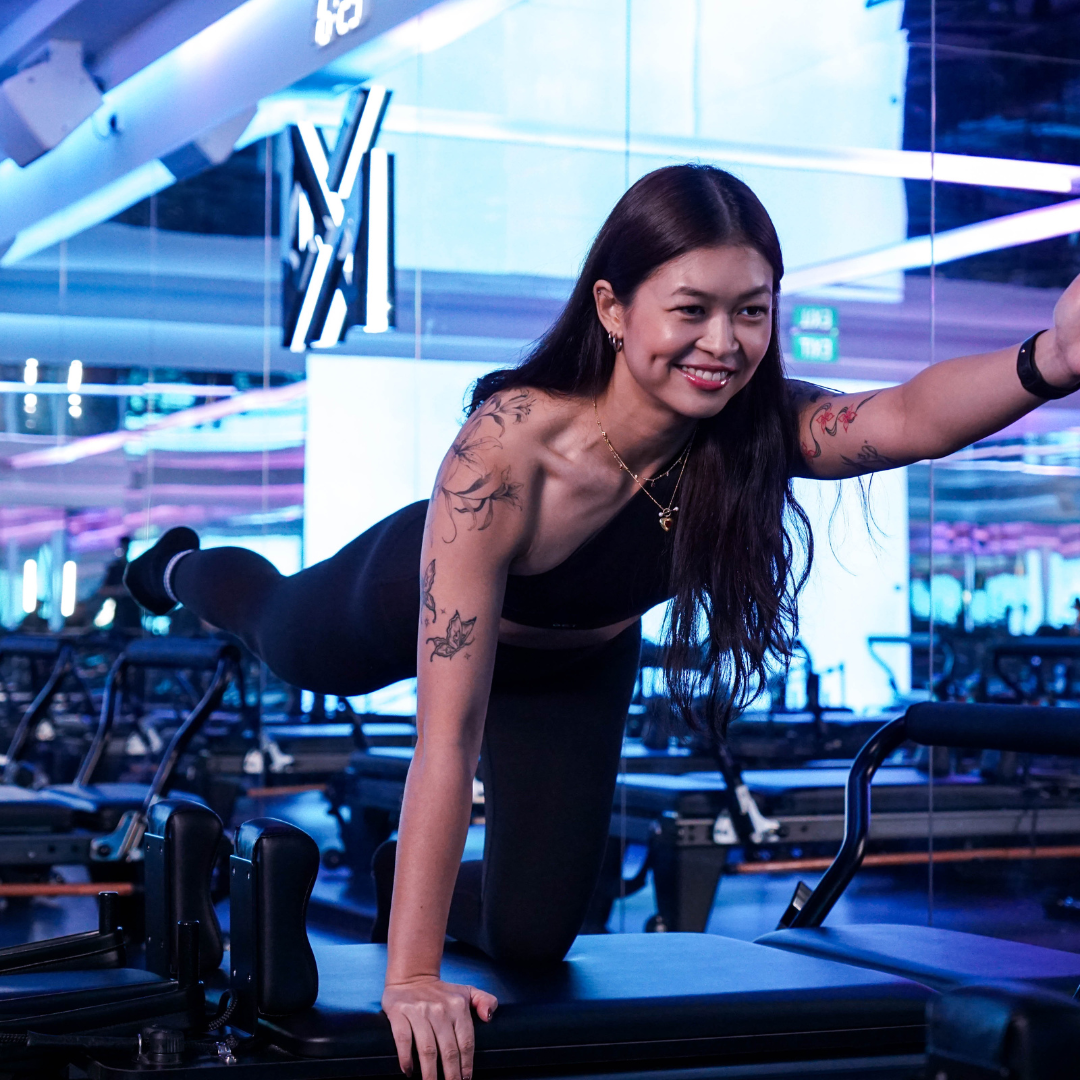
At first glance, reformer Pilates can look a little intimidating. There’s a moving platform, springs, straps, and legs flying in every direction. But the reformer’s real job is to support you, challenge you, and make every movement count.
So, what is reformer Pilates? It’s a style of Pilates performed on a specialized machine called a reformer. Using adjustable springs, pulleys, straps, and a sliding carriage, the reformer creates resistance and support for a full-body workout. Think of it as all the fixtures and fittings of a complete fitness studio – packed into one very clever machine.
Below, we break down what a reformer machine is, explore how reformer Pilates works, and unpack the reformer benefits and movements you can expect in your first VAURA class.
What is reformer Pilates?
Reformer Pilates is a form of exercise built around the reformer machine. It takes the same core principles as traditional mat Pilates – control, alignment, and breath – and adds resistance from the springs, straps, and pulleys to deeply tone and strengthen your muscles, all while minimizing the impact on your joints.
At VAURA, our workouts are based around the reformer but fused with the dynamic power of athletic training. Led by expert instructors and set in an energizing studio environment, we combine strength, cardio, and mobility work into every class – turning the reformer into a complete full-body workout that challenges you from every angle.
What is a reformer machine?
A reformer machine is a specialized piece of equipment that resembles a bed frame and utilizes several complementary components to deliver a full-body, resistance-based workout.
The carriage
The carriage is the padded platform you sit, lie, kneel, or stand on during class. It glides back and forth along the reformer’s frame, so your body has to work to control both the movement out and the return in.
The springs
Springs create the reformer’s resistance, offering up to around 70 lbs of load. Mixing and matching springs lets you target specific muscle groups and adjust the load to match your strength. During a VAURA workout, for example, we use:
- Yellow springs – light resistance for core stability, upper body, and balance.
- Blue springs – medium-light resistance for a broader range of exercises.
- Red springs – heavier resistance, mostly for lower body movements like presses and squats.
The straps and pulleys
The straps loop around your hands or feet, connecting to the springs. They extend the workout to your arms, shoulders and legs, adding resistance and range.
The footbar
Something to push, pull or brace against. It’s fully adjustable – raised, lowered or angled to suit the exercise and your body.
The platform and shoulder blocks
The platform is the sturdy base that keeps the carriage gliding smoothly. The shoulder blocks cushion and brace your shoulders when you’re pushing hard, keeping you anchored and aligned.
How does reformer Pilates work?
Reformer Pilates works by combining resistance, control, alignment, breath, and full-body coordination in every movement. Because the springs and setup can be adjusted in endless ways, there’s no limit to the workouts you can create – the same machine can help you build serious muscle strength one day and gently support you through lower back pain the next.
As VAURA trainer Cristina Chan explains, “My favorite thing about reformers is how adaptable they are. You can create so many different kinds of movement on the exact same machine. Want cardio? Our Jumpboard workouts will get your heart rate up without any impact on your joints. Looking to build serious strength? That’s where we bring in the heavier springs for VAURA Strength. And if you want a bit of both, Total’s got you covered. Or, if your body’s asking to slow down for a second, Stretch is all about balance and flexibility.”
Want to experience the benefits of reformer for yourself? Find a VAURA studio near you and start a trial – you might just discover your new favorite class!
What is reformer Pilates good for? 7 reformer Pilates benefits
Because there are so many different workouts you can create, there are just as many reformer Pilates benefits that come with this dynamic style of training. Below, we break down seven results you can expect from your VAURA workouts.
1. Builds full-body strength
Reformer Pilates challenges your arms, shoulders, core, glutes, legs, and postural muscles: all in one session. Strength is built differently in Pilates compared to the gym – whereas the gym isolates large muscle groups, the reformer rarely lets you target just one.
In a VAURA Strength class, every push or pull against the springs calls on your core and stabilizers too, turning a single exercise into a full-body effort.
2. Improves core control
Because the reformer carriage moves beneath you, your core has to work constantly just to stay stable, even in exercises that look like they’re targeting your arms or legs. Joseph Pilates, the method’s creator, called the core the “powerhouse,” since every movement in Pilates originates from your torso1.
That’s why your VAURA instructor will remind you to “engage your core” throughout class: the more you train that connection, the more control, stability, and strength you’ll carry into every other movement, on the reformer and off it.
3. Supports better posture and alignment
The reformer’s guided, controlled movement trains your body to hold better posture by targeting your deep spinal stabilizers, the small muscles that keep your spine supported2.
It’s one of the benefits of reformer Pilates that our members feel almost immediately, undoing the slouched posture that builds up from everyday habits like working behind a desk for long periods or sitting hunched over your smartphone.
4. Increases mobility and flexibility
Spring tension supports your body as you move through a deeper range of motion than you could safely reach alone. That makes it active, strength-based mobility – rather than passive stretching – which helps you build real flexibility that your muscles can actually use2.
As Chan explains, “People assume our Stretch classes are just a slow, easy cool-down. Really, we’re drawing on principles from Pilates and yoga to actively work the muscle as you lengthen it. That’s what makes the flexibility stick.”
5. Builds muscular endurance
Muscular endurance is your body’s ability to repeat an action without tiring, and it’s built through the slow tempos, pulses, and sustained holds you’ll find in reformer Pilates2. That extended time under tension is what tones your muscles and builds strength over time.
We incorporate these throughout all our workouts in exercises like pulsing lunges, slow-tempo leg presses, and extended planks. (You’ll hate us in the moment, but thank us later!)
6. Low-impact, high-challenge
Another reformer benefit is that it takes the pressure off your joints – since the carriage glides smoothly beneath you, instead of forcing you to push off a hard surface.
That’s what makes our Jumpboard workouts such an effective way to get your heart rate up – they give you all the cardio benefits of jumping, without the repetitive impact of landing on your knees and ankles.
It’s also why reformer Pilates is such an effective option during pregnancy and postpartum, helping you build and maintain strength without placing extra stress on your joints3.
7. Improves balance and coordination
Every reformer movement happens on an unstable, moving carriage, meaning your body has to constantly recalibrate to stay controlled. That constant small-scale correction is what trains your balance and coordination. This becomes increasingly important as you age, which is why Pilates in your 50s and beyond can be so beneficial4.
Common reformer Pilates movements
One of the biggest benefits of reformer for beginners is that there’s no steep learning curve. Every movement can be adjusted to your level with a simple spring change, so you’re never thrown in the deep end.
Read on to explore some reformer Pilates movements you’ll come across in our classes.
Bridges
You’ll often find bridges at the start of a class. They involve lifting your hips while your feet rest on the footbar or carriage, depending on the variation. Bridges target the glutes and hamstrings, while your core works to keep the movement controlled.
Reformer footwork
Performed lying on the carriage with your feet on the footbar, reformer footwork involves pushing the carriage away and slowly bringing it back in. Simple movement, serious payoff – it’s one of the clearest examples of reformer Pilates benefits in action, building strength through your legs, glutes, and calves while training alignment and control.
Lunges and scooter-style movements
These standing exercises use the moving carriage to challenge your glutes, quads, hamstrings, balance, and coordination. They’re often more dynamic, making these muscle-burning movements a staple in our high intensity sequences.
Plank variations
With your hands or feet on the moving carriage, a reformer plank challenges your core and shoulders to keep your body stable. Fewer springs make the movement harder – as you use your core strength to control the carriage with less support – while heavier springs provide more stability.
Strap-based arm work
Holding the reformer straps lets you perform movements such as rows, presses, flyes, bicep curls, and triceps extensions. This is an effective way to build upper-body strength and shoulder stability.
Feet-in-straps movements
You’ll find these at the end of our workouts. Lying on the carriage with your feet in the straps, you move through guided patterns like circles and extensions, while your instructor guides you through some breathing techniques to bring the session home.
Now, you know what a reformer machine is. But you didn’t think we’d stop there, did you? Next, learn about Pilates props and equipment and how we use them in our workouts.
1https://babel.hathitrust.org/cgi/pt?id=mdp.39015038069475&seq=16
2https://pubmed.ncbi.nlm.nih.gov/20145572/
3https://pmc.ncbi.nlm.nih.gov/articles/PMC12020081/
4https://www.hopkinsmedicine.org/health/wellness-and-prevention/fall-prevention-exercises