
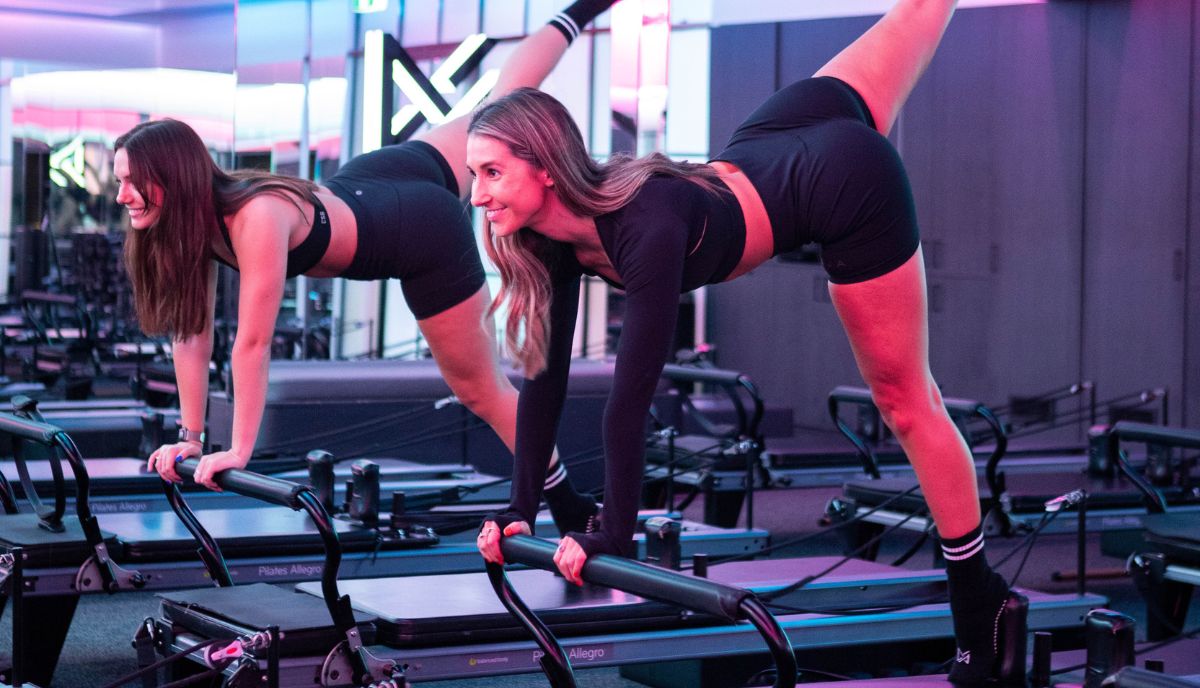
Pilates might be famous for its core-strengthening benefits – but your legs get plenty of attention, too. From pushing against reformer springs and holding lunges to balancing on alternate legs, there’s a lot more to Pilates leg exercises than you might expect.
Your quads, hamstrings, glutes, calves, and inner and outer thighs all have a role to play. And at VAURA, our workouts take things further by fusing the precision of reformer and mat modalities with athletic strength training – making for a more kinetic, dynamic approach to Pilates that will leave your heart (and your legs!) pounding.
Whether you’re looking to build lower-body strength, improve balance, or switch up your usual leg day, we’ve rounded up eight of the most effective Pilates moves for legs – with tips for practicing them, and how they help you build strength across your lower body.
Is Pilates good for your legs?
Absolutely! Pilates can be an effective way to build lower-body strength, improve muscular endurance, and develop better balance and coordination1.
What makes it particularly versatile is how easily you can adjust the challenge. On the mat, a simple leg exercise can feel completely different when you slow down the tempo, add a few pulses, hold a position, or switch to a single-leg variation. On the reformer, meanwhile, spring tension adds another element. Your legs generate force to move the carriage, but they also have to control its return2. This makes both phases of the exercise valuable for practicing good technique and developing strength through time under tension.
At VAURA, we also use Pilates props and equipment (such as resistance bands, dumbbells, and ankle weights) to offer more ways to increase the difficulty as your confidence and ability – not to mention your leg strength! – grow. And remember, more resistance isn’t always better. Good technique, a comfortable range of motion, and gradual progression will help you get the most out of your Pilates leg workouts at your local VAURA studio.
What leg muscles does Pilates work?
One of the biggest benefits of Pilates moves for legs is how many muscle groups you can target in a single session. Different exercises emphasize different areas, so let’s take a closer look at what’s involved.
Quadriceps
Your quads are the four muscles at the front of your thighs, which are responsible for straightening your knees. They’re particularly active during squats, lunges, reformer footwork, and jumpboard exercises, where they generate power as you push away from the footbar or floor.
Hamstrings
Located along the backs of your thighs, your hamstrings bend your knees and assist with hip extension. They’re also crucial in other forms of exercise beyond Pilates, such as running. Think bridges, leg curls, and controlled reformer movements. Your hamstrings often work alongside your glutes, especially when lifting your hips or extending your legs behind you.
Glutes
Your glutes consist of three muscles: the gluteus maximus, medius, and minimus. Together, they contribute to hip movement, pelvic stability, and balance, making them particularly important during single-leg Pilates exercises.
Inner and outer thighs
Pilates isn’t all about moving forward and backward. Sideways movements can also challenge areas that traditional leg workouts sometimes overlook.
Your inner thigh muscles (adductors) draw your legs toward your body’s midline, while muscles around your outer hips help move your legs outward and stabilize your pelvis. Side splits and lateral Pilates leg exercises are great examples of both muscle groups in action.
Calves
Your calves do more than help you rise onto your toes. They contribute to ankle control, balance, and pushing through your feet during lower-body movements.
You’ll recruit them during standing Pilates leg exercises, reformer footwork, and VAURA’s JUMPBOARDS sequences, particularly when extending through your ankles and controlling your landings.
8 Pilates leg exercises to try at VAURA
Ready to give your lower body some attention? These eight Pilates leg exercises target everything from your quads and hamstrings to your glutes and calves. Some will feel familiar, while others put a fresh spin on traditional strength moves using the reformer.
1. Reformer footwork
Targets: Quads, hamstrings, glutes, and calves.
One of our favorite reformer Pilates leg exercises, footwork might look simple – but it’s a super effective way to build strength throughout your legs. Lying on your back with your feet against the footbar, press through your feet to move the carriage away, then gradually bend your knees to return. Changing your foot position – between heel and toe positions or adopting a wider stance – will help shift the emphasis between muscle groups.
Want more of a challenge? Try a single-leg variation to test your strength and stability on each side.
2. Reformer lunges
Targets: Quads, glutes, hamstrings, and hip stabilizers.
Lunges are a staple of Pilates leg workouts, and adding a moving reformer carriage brings a whole new challenge3.
In a standing lunge variation, one foot stays on a stable surface while the other moves with the carriage. As you bend your supporting knee and slide the carriage away, your legs have to manage both the resistance and your balance. Maintaining an upright torso and steady pelvis is just as important as the movement itself, helping you develop the body awareness and alignment that make Pilates for posture so beneficial.
Your VAURA instructor can adjust the springs, range of motion, and tempo to suit your experience – or introduce pulses for an extra challenge!
3. Side splits
Targets: Inner thighs, outer hips, glutes, and core.
Looking for a Pilates thigh workout that goes beyond squats and lunges? Try side splits.
Standing with one foot on the reformer’s stable platform and the other on the carriage, slowly open your legs against the spring tension before drawing them back together. Your inner thighs play a particularly important role in bringing the carriage home, while your outer hips and glutes help keep you steady4. Start with a smaller range of motion while you get comfortable with the movement – and remember to regulate your breathing throughout.
4. Feet in straps
Targets: Hamstrings, glutes, inner thighs, and hip muscles.
Here’s a Pilates leg movement you might recognize from your last reformer class. Lie on your back with your feet supported in the straps, then move your legs through a series of guided positions.
Depending on the exercise, you might press your legs away, bend your knees or open and close your hips against the springs. The straps allow you to explore different angles of movement while maintaining steady resistance, making this a versatile option for developing lower-body strength and coordination.
5. Reformer leg circles
Targets: Hip muscles, hamstrings, adductors, glutes, and core stabilizers.
Leg circles take the feet-in-straps setup in a different direction – quite literally! With your legs extended into the straps, trace smooth circles through the air while keeping your pelvis steady. You can adjust the size and direction of each circle to change the difficulty.
The real challenge is preventing your hips from rocking as your legs travel through the movement. This calls for core control and pelvic stability, both of which are also important considerations when exploring Pilates for lower back pain. Start with smaller, deliberate circles before increasing your range.
6. Scooter
Targets: Glutes, hamstrings, quads, and hip stabilizers.
The Scooter is a fantastic single-leg Pilates exercise for building strength and balance.
Standing beside the reformer with one foot planted on the floor and the other against the carriage, push your moving leg backward before bringing it forward again.
Your standing leg provides stability while the moving leg challenges your glutes and hamstrings. Try slowing the return phase to make each repetition more demanding without necessarily adding resistance.
7. Squats
Targets: Quads, glutes, hamstrings, and inner thighs.
You probably already know how to squat, but Pilates gives this familiar leg-day favorite plenty of room for variation.
Begin with your feet approximately hip-width apart, bend at your hips and knees to lower into a squat, then press through your feet to stand tall. At VAURA, we use dumbbells, resistance bands, slower tempos, or small pulses to turn a basic squat into a more demanding Pilates leg exercise – helping you level up as you progress from your first class to your 100th. Experimenting with your stance can also shift the emphasis across your thighs and glutes.
8. Jumpboard exercises
Targets: Quads, glutes, hamstrings, and calves.
Want to add a little cardio to your Pilates leg workout? VAURA’s JUMPBOARDS classes bring a more athletic element to the reformer.
With a jumpboard attached at the foot of the machine, you lie on the carriage and push away from the board using your legs. As you return, bend your knees to absorb the landing before preparing for the next repetition. Research comparing reformer jumping with hopping on the ground found lower loading rates and peak hip-joint forces during reformer jumps – so it’s less demanding on your body than other forms of higher-impact exercise5.
From two-legged jumps to alternating-leg sequences, there are plenty of ways to increase the intensity here – all while developing your strength and muscular endurance.
Now we’ve unpacked the advantages of leg Pilates for women (and men!), discover the broader benefits of reformer and mat Pilates with our guide to Pilates for stress relief.
Otherwise, get in touch with the team here at VAURA to find out more about what we do – and how we might just be the extra motivation your leg-day needs!
1 https://pubmed.ncbi.nlm.nih.gov/22030232
2 https://www.scielo.br/j/fm/a/4KxMz9ybPJttLmq7SrhQDWb
3 https://pmc.ncbi.nlm.nih.gov/articles/PMC7112217